Treasury Auction Sizes Held Steady in May 2026 Refunding
Treasury's May 6, 2026 refunding set $125 billion of 3-, 10- and 30-year auctions, kept coupon sizes unchanged and projected $671 billion of Q3 borrowing.
WASHINGTON — The Treasury Department said on May 6, 2026 that it would keep Treasury auction sizes for notes, bonds and floating-rate notes unchanged, setting $125 billion in long-term securities for its quarterly refunding and repeating its expectation that coupon sizes would hold for at least the next several quarters. The announcement, delivered by Deputy Assistant Secretary for Federal Finance Brian Smith, gave the bond market a steady supply outlook at a time when energy-driven inflation was pushing yields higher.
The Treasury auction package
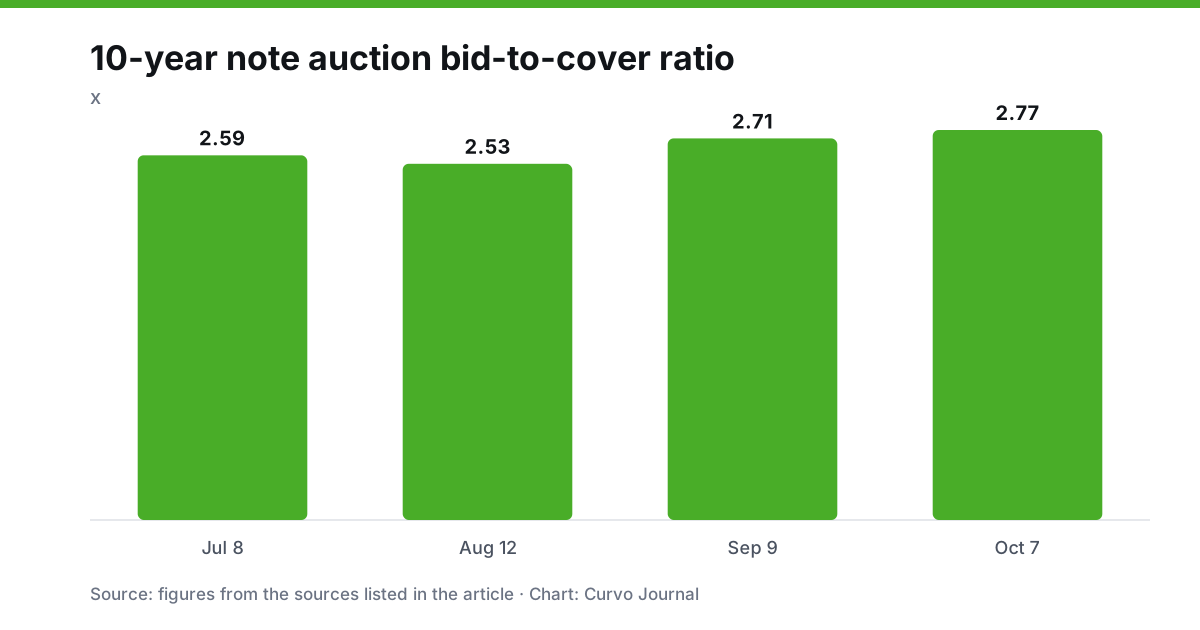
The May refunding consisted of three sales: $58 billion of 3-year notes on May 11, $42 billion of 10-year notes on May 12 and $25 billion of 30-year bonds on May 13. Together the auctions would refinance about $83.3 billion of maturing notes and raise roughly $41.7 billion in new cash.
The key line for investors was the guidance. Treasury said that, based on current projections of borrowing needs, it anticipated maintaining nominal coupon and floating-rate note auction sizes for at least the next several quarters. That language has become a fixture of refunding statements, and dealers watch closely for any change in wording that might foreshadow larger auctions. Its repetition in May meant the government planned to absorb any increase in financing needs through Treasury bills rather than longer-dated debt.
Borrowing estimates point to a heavy summer
Two days earlier, on May 4, Treasury released its marketable borrowing estimates. For the April-to-June quarter it expected to borrow $189 billion in privately held net marketable debt, assuming an end-of-June cash balance of $900 billion. That estimate was $79 billion higher than the figure Treasury had published in February, a change it attributed to lower projected net cash flows, partly offset by a higher-than-assumed cash balance at the start of the quarter.
The bigger number was for July through September, when Treasury expected to borrow $671 billion, assuming a cash balance of $950 billion at the end of September. In the refunding statement, Treasury also said the cash balance in the Treasury General Account could reach about $1 trillion, plus or minus $50 billion, in late July.
For the January-to-March quarter just ended, Treasury reported borrowing of $577 billion, close to its February estimate of $574 billion, and an end-of-quarter cash balance of $893 billion compared with an assumed $850 billion.
Bills, TIPS and buybacks
With coupon sizes fixed, the statement described the other tools Treasury would use. Weekly bill auctions and cash management bills would continue, alongside regular monthly sales of Treasury inflation-protected securities and 2-year floating-rate notes.
Treasury also outlined its buyback program for the quarter. It planned to buy back up to $38 billion of off-the-run securities across maturity buckets for liquidity support, and up to $25 billion in the 1-month to 2-year bucket for cash management purposes. Buybacks let Treasury retire older, less liquid issues and smooth its cash flows, a modest but useful support for trading conditions in the less active parts of the curve.
Why it matters for the curve
Steady coupon sizes mean the supply of 10- and 30-year debt would not rise in the near term, which removes one potential source of upward pressure on long-term yields. But the large summer borrowing estimate means bill issuance would have to climb, which shifts more of the financing burden to the front end of the curve. When the Fed is holding its policy rate steady, heavier bill supply tends to be absorbed by money market funds and other short-term investors, often with little effect on longer yields. When markets begin to price a rate increase, the front end becomes more sensitive to that supply.
The bond market’s reaction to the refunding auctions themselves would provide the next test. The 10-year note on May 12 and the 30-year bond on May 13 would show how much long-term investors were willing to pay for duration with inflation running well above the Fed’s goal.
What to watch
The August refunding, scheduled for early in that month, is the next point at which Treasury could change its guidance. Watch the wording on coupon sizes, any shift in the projected cash balance, and the size of bill auctions over the summer as the $671 billion borrowing estimate is put into practice. A move to larger coupon auctions would add duration supply to a market already adjusting to higher inflation expectations.
Prepared with AI assistance from public sources and reviewed under our editorial policy. Not investment advice.