Bond Market Rate Volatility Keeps Spreads Wide Ahead of 30-Year Sale
ING says elevated rate volatility, set off by the 10-year Treasury passing 5%, keeps European bond spreads wide as the US sells $22 billion of 30-year bonds.

LONDON — Government bond spreads in Europe will not tighten on political will alone while global interest-rate volatility stays high, according to ING, and the swing factor is the US Treasury market. With the 10-year Treasury yield having passed 5 percent, the bank’s rates strategists say a return to the quiet conditions that favored carry trades looks unlikely, a view that raises the stakes for the 30-year bond sale scheduled in Washington on Thursday.
Key takeaways
- ING’s Michiel Tukker says European government bond spreads face pressure from a more volatile global rates backdrop than at the start of the year.
- US implied volatility rose when the 10-year Treasury yield crossed 5 percent, and that move is a main driver of euro rate volatility.
- ING expects rate volatility to remain elevated for the coming months, at least, with inflation the biggest unknown.
- The Treasury sells $22 billion of 30-year bonds Thursday.
How carry trades stopped working
Before the Middle East conflict began in March, Tukker wrote, financial conditions were favorable for carry strategies: borrow at low, stable short rates and buy longer-dated sovereign bonds. In leveraged form, the trade can earn attractive returns, and it supported demand for French, Italian and Spanish government bonds, which helped narrow their spreads to Germany.
Rate volatility has spiked in recent weeks, he said, and the effect is not confined to Europe. The 10-year Treasury moving through 5 percent lifted US implied volatility, which feeds directly into euro-area volatility. The same global driver explains why Italian bonds sold off in a similar pattern to French ones, in his view. Europe alone, he concluded, lacks the tools to push spreads back to earlier lows.
Inflation is the unknown
ING’s central view is that second-round inflation risks are more benign than markets are pricing, but the bank acknowledges that markets and central banks need more data to gain confidence. Until then it expects volatility to stay high. That conclusion carries a direct message for investors in Treasuries: the same uncertainty that widens spreads in Paris and Rome shows up in term premium in Washington, because both reflect how much compensation holders require for owning duration.
The Thursday calendar
The day is crowded with policy speakers. ING lists the ECB’s Moulin, Lane and Stournaras, the Bank of England’s Greene, Pill, Lombardelli and Governor Bailey, and the Fed’s Waller, Kashkari and Musalem. The ECB publishes the minutes of its September meeting, and in Europe the Eurogroup meets in Luxembourg with ECB President Lagarde attending. Italy is due to hold a final vote on an election reform. The only major US data point is weekly jobless claims.
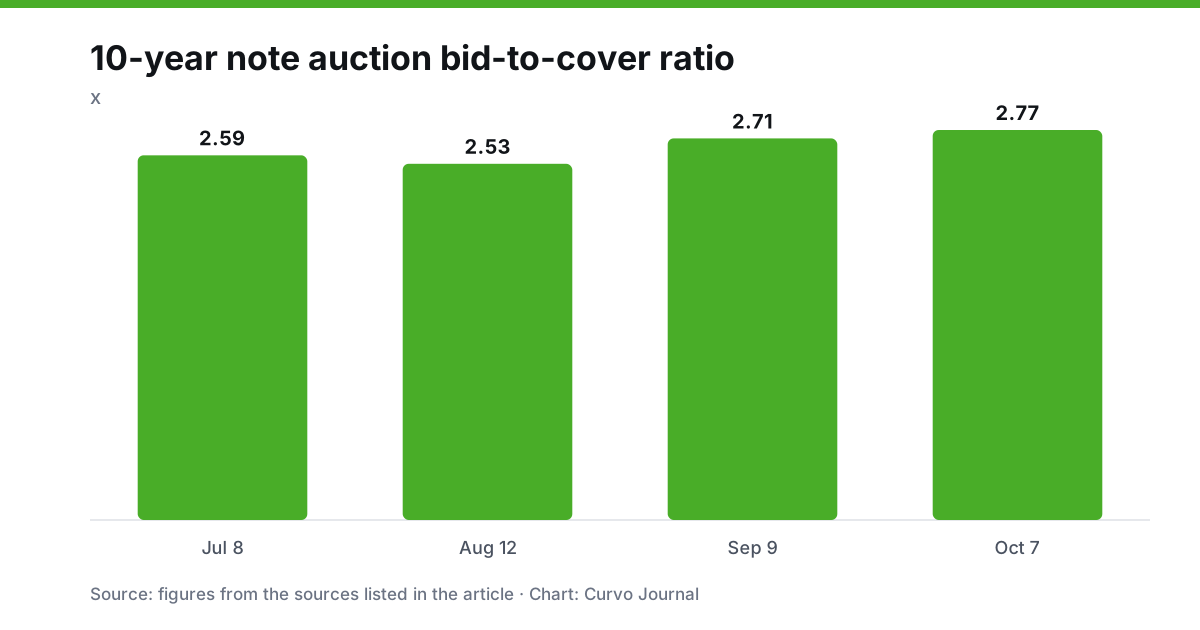
For supply, the Treasury is selling a $22 billion reopening of the 30-year bond with a 5.125 percent coupon, maturing in August 2056, according to TreasuryDirect. The last 30-year sales cleared at 5.216 percent in August (bid-to-cover 2.39) and 5.308 percent in September (2.61).
Why a US yield drives a European spread
The transmission runs through volatility rather than through level alone. Leveraged carry trades depend on predictable funding costs: if the cost of borrowing or the price of the bond swings widely, the cushion that made the trade attractive disappears. When implied volatility on US rates rises, dealers and leveraged investors reduce risk in other markets too, and the highest-yielding sovereign spreads in the euro area are the most exposed. ING names French, Italian and Spanish government bonds as frequent components of the carry trade, which leaves them exposed when it unwinds.
For Treasury investors the message is similar: a market that leans on stable volatility to absorb supply is vulnerable when volatility rises.
What to watch
The 30-year result will show whether long-end buyers are comfortable at yields above 5 percent. A weak sale would feed the volatility ING describes, while a well-received one would suggest demand is deeper than the recent selloff implied. Either way, ING’s message is that European spreads and US yields now share a common volatility driver.
Prepared with AI assistance from public sources and reviewed under our editorial policy. Not investment advice.