Bond Prices and Yields Explained: Why They Move Opposite
Bond prices and yields explained: why they move in opposite directions, how coupon, maturity and duration matter, and how to read yield quotes on Treasuries.
Bond prices and yields move in opposite directions. When the price of a bond rises, its yield falls, and when the price falls, its yield rises. The relationship is arithmetic, not a market habit: a bond promises fixed payments, so paying more for the same payments earns a lower return, and paying less earns a higher one.
That single idea explains most of what is said about the bond market. When a news report says Treasury yields jumped, it also means that the prices of existing Treasury securities fell. This guide explains the pieces behind that relationship, including coupon, maturity, yield and duration, with a worked example and pointers to official sources.
In brief
- A bond is a loan: the issuer pays periodic interest, called the coupon, and repays the face value at maturity.
- Yield is the return an investor earns given the price paid. It changes as the price changes.
- When market interest rates rise, existing bonds with lower coupons lose value; when rates fall, they gain.
- Longer maturities and lower coupons make a bond’s price more sensitive to rate changes.
- A bond held to maturity returns its face value, assuming the issuer pays, regardless of price swings in between.
The parts of a bond
The SEC’s Investor.gov explains the basics. A bond is a debt security. The issuer, which can be a government, a municipality or a corporation, borrows money from investors and promises to pay interest on a schedule and to repay the principal at maturity.
Face value or par. The principal amount the issuer repays at maturity. Bonds are quoted relative to par, so a price of 100 means par.
Coupon. The fixed interest rate, stated as a percentage of face value. Treasury notes and bonds pay interest every six months. A note with a 4 percent coupon and a face value of $1,000 pays $40 a year, in two installments of $20.
Maturity. The date the principal is repaid. Treasury securities range from a few weeks for the shortest bills to 30 years for bonds, according to Investor.gov and TreasuryDirect.
Price. What the bond costs in the market. After issuance, the price changes constantly with market conditions. It can be above par, called a premium, or below, called a discount.
Yield. The return implied by the price, the coupon and the time to maturity. Several yield measures exist, and they answer slightly different questions.
Why prices and yields move in opposite directions
Suppose an investor owns a bond with a 4 percent coupon. If market interest rates rise so that newly issued bonds of similar quality pay 5 percent, nobody will pay full price for the older 4 percent bond when a 5 percent bond is available. Its price must fall until buying it offers a return comparable to the new bonds. Investor.gov puts it this way: when rates rise, newer bonds pay more, so older bonds with lower rates have to sell at a discount to attract buyers.
The reverse also holds. If market rates fall to 3 percent, the older 4 percent bond becomes more attractive, and buyers will bid its price above par. The coupon payments have not changed. What has changed is the return a buyer would get at the new price.
Types of yield
Current yield. The annual coupon divided by the current price. A 4 percent coupon bond priced at 95 has a current yield of about 4.2 percent. It ignores the gain or loss when the bond reaches par.
Yield to maturity (YTM). The annualized return an investor earns if the bond is bought at today’s price and held until maturity, with all coupons reinvested at the same rate. When people quote the yield on a Treasury security, they usually mean the yield to maturity. Because the price converges to par at maturity, a discount bond has a yield above its coupon and a premium bond has a yield below it.
Par yield. The coupon rate at which a bond of a given maturity would be priced at par. The Treasury’s official daily yield curve is stated in these terms, built from market prices of recently auctioned securities using a monotone convex method, according to Treasury’s methodology page.
Discount rate and bond-equivalent yield for bills. Treasury bills pay no coupon and are sold at a discount. Their rates are quoted on a discount basis and are converted to a bond-equivalent yield for comparison with notes and bonds, a step Treasury describes in its curve methodology.
Real yield. The yield adjusted for expected or realized inflation. Treasury publishes real yield curve rates based on TIPS, which show the return after inflation.
Maturity, coupon and sensitivity
Not all bonds react equally to a given change in rates. Two features matter most.
Maturity. A longer maturity means a longer stream of fixed payments exposed to changing rates. The price of a 30-year bond will typically move more than the price of a 2-year note when yields change by the same amount.
Coupon. A lower coupon means more of the value arrives at maturity, further in the future, which makes the price more sensitive. A zero-coupon bond is the most sensitive for its maturity.
Analysts summarize both effects in a measure called duration, expressed in years. Duration is an estimate of the percentage change in a bond’s price for a one percentage point change in yield. A bond with a duration of 7 would be expected to lose roughly 7 percent of its price if yields rose by one percentage point, and to gain roughly 7 percent if yields fell by the same amount. The estimate is an approximation, and it works best for small changes. A related measure, convexity, captures how the sensitivity itself changes as yields move.
A worked example
Take a Treasury note with a face value of $1,000, a 4 percent coupon and a 10-year maturity, bought at par. Its yield is 4 percent, and it pays $40 a year.
A year later, similar 9-year notes are yielding 5 percent. A buyer will no longer pay $1,000 for a note paying $40, since new notes pay more. The price falls until the yield on the older note is also around 5 percent. For a 9-year note, that works out to a price of roughly $930, though the exact figure depends on the pricing formula. The owner has a paper loss. If the owner holds it to maturity, however, the note will still pay back $1,000, and the owner will have received all of the coupons. The loss is realized only if the note is sold at the lower price.
Now reverse the scenario. If similar notes yield 3 percent a year later, the price of the older note rises to roughly $1,080. The owner has a paper gain, and a new buyer at that price earns about 3 percent. The figures are approximations meant to illustrate direction and scale.
Risks beyond interest rates
Interest rate risk is the main price risk for high-quality government bonds, but it is not the only one. Investor.gov also describes call risk, which arises when an issuer can redeem a bond early, usually when rates have fallen, so the investor must reinvest at lower yields. Credit risk matters for corporate and municipal bonds, since an issuer might fail to pay. Treasury securities carry the backing of the U.S. government, which is why they are treated as the benchmark risk-free asset in the sense of credit. Inflation risk affects fixed payments, since rising prices erode their purchasing power, which is the reason TIPS exist. Liquidity risk is the possibility that a bond cannot be sold quickly at a fair price, which is rarely a concern for Treasuries but can matter for smaller issues.
Reading yield quotes in the news
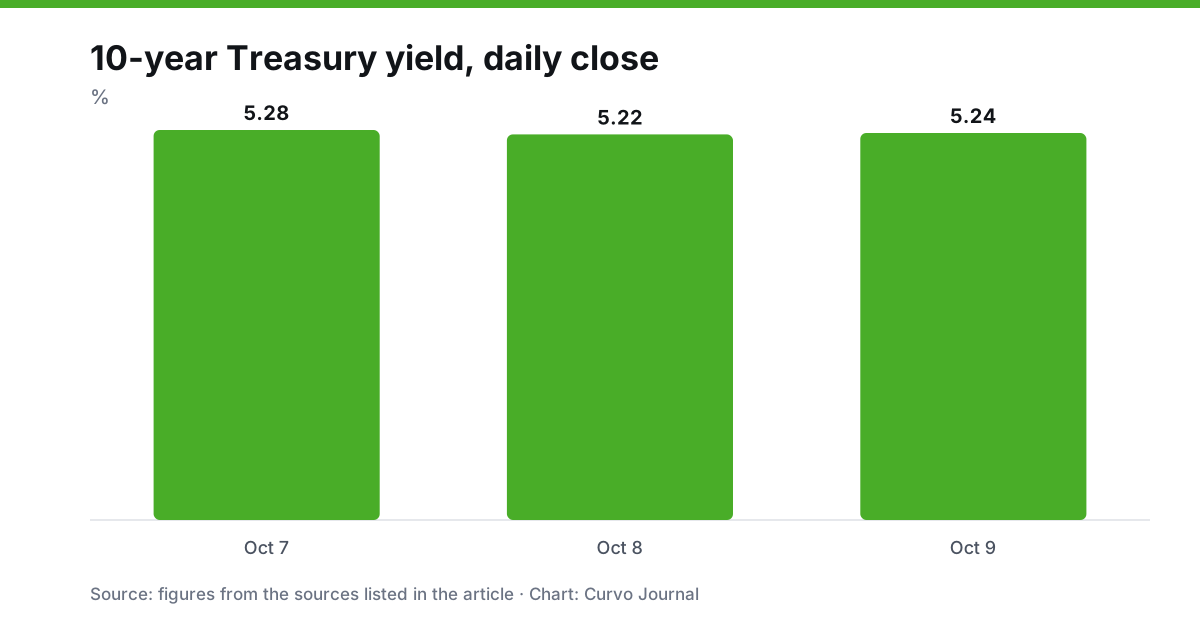
When a report says the 10-year Treasury yield rose to a certain level, it refers to the yield to maturity on the benchmark 10-year note. A rise of 0.10 percentage point, also called 10 basis points, means the price of that note fell. The size of the price change depends on duration. Reports often pair yield changes with economic releases, such as inflation or employment data, because those releases change expectations about the Federal Reserve’s policy rate, which in turn changes what investors will pay for existing bonds. Yields on the 10-year Treasury also feed into mortgage rates and corporate borrowing costs, as many loans are priced relative to Treasury yields.
For official data, the Treasury publishes the daily par yield curve rates, and the Federal Reserve publishes Treasury yields in its H.15 release. Both are free and updated each trading day.
FAQ
Why do bond prices fall when interest rates rise?
Because new bonds pay higher coupons, existing bonds with lower coupons are worth less. Their prices drop until their yield is competitive with new issues.
Do I lose money if bond prices fall?
Only if you sell at the lower price. A bondholder who keeps a bond to maturity receives the face value and the coupon payments, assuming the issuer does not default.
What is yield to maturity?
It is the annualized return from buying a bond at its current price and holding it until it matures, with coupons reinvested at the same rate.
What is duration?
It is a measure, in years, of a bond’s price sensitivity to changes in yield. A higher duration means larger price swings for a given change in rates.
Are Treasury bills priced like bonds?
Bills pay no coupon and are sold at a discount to face value. Their return is the difference between the purchase price and face value, and the same inverse relationship applies.
Where can I see current Treasury yields?
On the Treasury’s Data and Charts Center for the daily par yield curve, and on the Federal Reserve’s H.15 release.
Prepared with AI assistance from public sources and reviewed under our editorial policy. Not investment advice.