Fed Minutes Show Three Dissents for a Hike as Treasury Yields Rose
FOMC minutes show a 9-3 vote to hold at 3.5%-3.75%, with three officials wanting a hike and many saying tightening may be needed if inflation does not decline.
WASHINGTON — Three Federal Open Market Committee members wanted to raise interest rates at the July 28-29 meeting, and many of their colleagues said tightening would probably be needed if inflation fails to decline, according to minutes released Wednesday. The committee still held the federal funds target range at 3-1/2 to 3-3/4 percent, but the 9-3 vote and the tone of the discussion show a central bank leaning toward a firmer stance, with Treasury yields already moving that way.
Key takeaways
- Beth Hammack, Neel Kashkari and Lorie Logan dissented, each preferring a 25 basis point increase.
- Nominal Treasury yields rose 25 to 30 basis points, driven by higher real yields, the minutes record.
- Before the meeting, markets priced about a one-in-three chance of a July hike and fully priced a quarter-point increase by September.
- A couple of participants discussed episodes of Treasury price volatility and ways to make them less likely.
A committee leaning toward a hike
The minutes describe inflation as elevated and broad-based. Total PCE inflation was 4.1 percent in May, with core at 3.4 percent, and staff estimated June readings of 3.7 percent and 3.3 percent. Most participants expected inflation to decline over the rest of the year, but many saw a risk that it could stay persistently elevated. Some noted large price increases for data-center materials such as chips and steel, and price pressures on items such as electricity.
The labor market looked balanced. Unemployment was 4.2 percent in June and average hourly earnings were up 3.5 percent from a year earlier. Several participants noted strong demand for skilled workers in AI-linked sectors, while a few pointed to lingering softness, including a low job-finding rate and elevated long-term unemployment.
On policy, many participants said that if inflation did not decline, tightening would likely be needed. The staff outlook saw inflation easing in the second half as gasoline prices fall, with risks to inflation skewed to the upside and risks to employment and growth skewed to the downside. The committee retained the statement language, added in June, that it “will deliver price stability.”
Treasury yields and market pricing
For the bond market, the more useful passages concern financial conditions. The minutes say nominal Treasury yields rose 25 to 30 basis points, with higher real yields doing most of the work. Market pricing ahead of the meeting showed roughly a one-in-three chance of a July increase, a fully priced quarter-point hike by September and another by the end of the first quarter of 2027. The dealer survey median, by contrast, expected no change in 2026 or 2027 and a cut in early 2028, a wide gap between market pricing and surveyed expectations.
A couple of participants also discussed episodes of Treasury price volatility and ways to reduce their likelihood. Staff continued to rate financial-system vulnerabilities as notable, citing near-record hedge fund leverage and record repo and prime brokerage borrowing. A few participants flagged financing for AI infrastructure, including borrowing from nonbank investors and regional banks.
What the August auctions showed
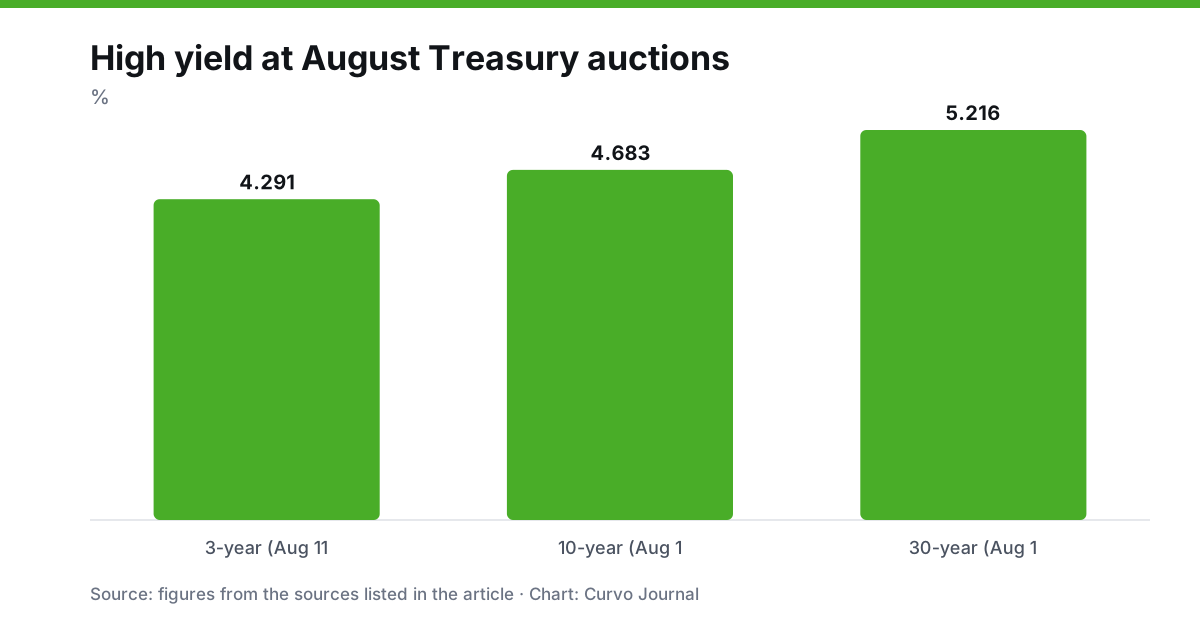
TreasuryDirect results from the preceding week fit that picture of a market demanding more yield for longer duration. A $58 billion 3-year note sold August 11 at a high yield of 4.291 percent. A new $42 billion 10-year note followed on August 12 at 4.683 percent, and a $25 billion 30-year bond on August 13 at 5.216 percent. The 3-year-to-30-year gap of about 93 basis points is a steep slope across the curve, and bid-to-cover ratios were 2.71, 2.53 and 2.39, thinning as maturities lengthened.
Balance sheet and what to watch
Most participants supported a comprehensive discussion of balance sheet policy at a future meeting, while many reaffirmed that the federal funds rate remains the primary tool. The chairman raised the idea of holding six meetings a year, but no decision was made and the 2026 calendar will not change.
The next meeting is September 15-16, and the committee will publish new projections then. Readers watching the 10-year Treasury should track whether inflation data validate the staff’s expected decline, since many participants said a stall in inflation would call for tightening.
Prepared with AI assistance from public sources and reviewed under our editorial policy. Not investment advice.