Fed Discount Rate Minutes: What They Mean for Treasury Yields
Fed minutes show the primary credit rate held at 3.75% in June as directors cited steady activity and fuel costs. What it means for Treasury yields now.
WASHINGTON — The Federal Reserve Board on Tuesday released the minutes of two June meetings at which it set the discount rate, a small administrative document that nonetheless offers a view of how the central bank’s directors read the economy just as the Treasury market works through a heavy run of July auctions. The record shows no appetite for change: the Board approved the primary credit rate at 3.75 percent on both June 8 and June 17.
Key takeaways
- The primary credit rate stayed at 3.75 percent, the top of the 3-1/2 to 3-3/4 percent federal funds target range the FOMC left unchanged on June 17.
- Reserve Bank directors described conditions as steady or resilient, with low but stable hiring and persistent fuel-cost pressure.
- The Board’s discount rate process is separate from the FOMC’s rate-setting, so the minutes are a read on sentiment rather than a policy signal.
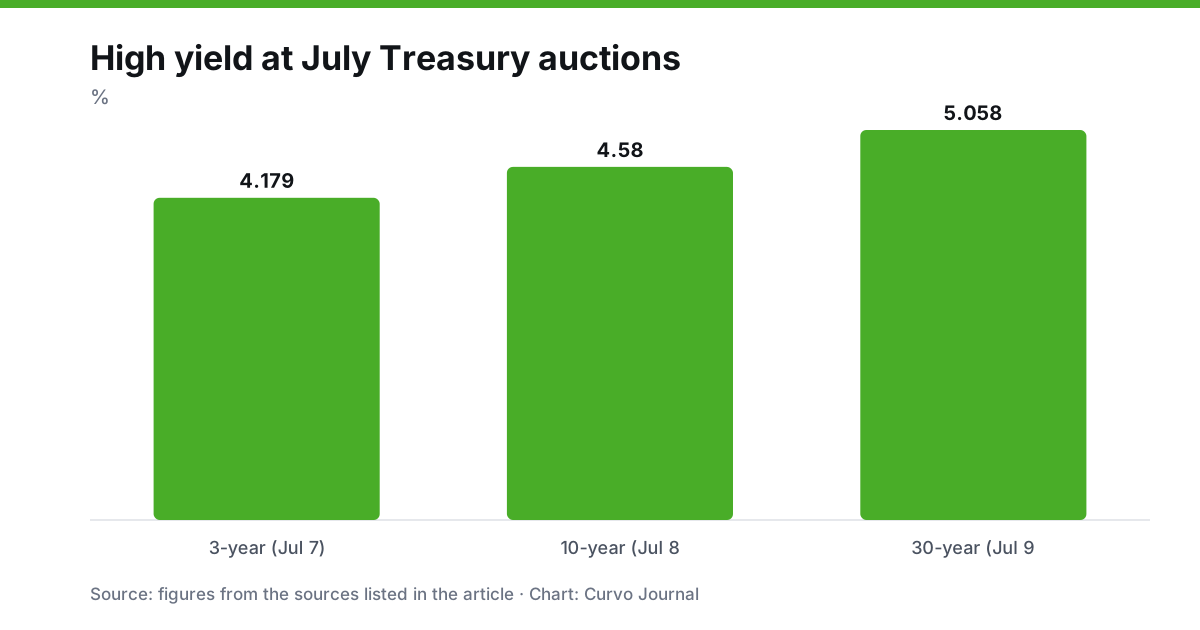
- Auction yields climbed with maturity in July’s coupon sales, from 4.179 percent at the 3-year sale to 5.058 percent at the 30-year.
What the Board decided
At its June 8 meeting the Board considered requests from the twelve Reserve Banks to keep the primary credit rate where it was and to renew the formulas for secondary and seasonal credit. The directors of the New York, Richmond, Kansas City and Dallas banks had voted on May 28, and the other eight banks on June 4, for the unchanged 3.75 percent rate. The Board said no sentiment was expressed for changing it.
The June 17 action came alongside the FOMC decision to hold the federal funds target range at 3-1/2 to 3-3/4 percent, effective June 18. The Board kept the interest rate on reserve balances at 3.65 percent and again approved the primary credit rate at 3.75 percent. The secondary credit rate stays pegged 50 basis points above the primary rate, while the seasonal rate resets every two weeks from the average of the daily effective federal funds rate and the three-month CD rate. The votes listed Chairman Warsh, Vice Chair Jefferson, Vice Chair for Supervision Bowman and Governors Powell, Waller, Cook and Barr.
What the directors reported
The more informative passage is the directors’ summary. Across Districts, they said economic conditions were steady or resilient. Hiring remained low but stable in most regions, and many directors pointed to the growing effect of artificial intelligence on current and future employment levels. Cost pressure persisted, especially from fuel prices and surcharges, with firms showing a mixed ability to pass those costs through. Uncertainty from global developments continued to weigh on business spending and hiring.
For Treasury investors, that mix matters because it describes an economy neither overheating nor weakening, with an inflation impulse that comes from energy rather than demand. That combination keeps the debate over the path of short-term rates open and leaves the front end of the yield curve sensitive to each data release.
The July auction calendar
The minutes arrived a week after a busy run of coupon auctions in the bond market. According to TreasuryDirect results, the $58 billion 3-year note sold July 7 at a high yield of 4.179 percent with a bid-to-cover ratio of 2.60. The next day a $39 billion reopening of the 10-year cleared at 4.580 percent (bid-to-cover 2.59), and on July 9 a $22 billion reopening of the 30-year bond cleared at 5.058 percent (bid-to-cover 2.44).
Those three results trace a clear upward slope of roughly 88 basis points from the 3-year to the 30-year. Demand was steady rather than exceptional, and the bid-to-cover ratio drifted lower as maturity lengthened, which is the usual pattern.
What to watch
The discount rate itself is unlikely to move before the FOMC does. Readers watching Treasury yields should look instead to the next set of FOMC minutes and the 20-year bond reopening and the 10-year TIPS sale later in July for signs of how much term premium buyers are demanding. The Fed notes that its discount rate process is distinct from the FOMC’s setting of the federal funds target range, and the June record bears that out: the Board matched, rather than led, the committee.
Prepared with AI assistance from public sources and reviewed under our editorial policy. Not investment advice.